

Search result for: the-last-thing-you-aquired-
| # | Post Title | Result Info | Date | User | Forum |
| Common sense isn't common... | 1 Relevance | 22 years ago | Olive | General discussion | |
| Common sense isn't common... This is an unfortunate truth brought on by the overwhelming data onslaught that we now live with in our daily lives. In many ways we are now conditioned NOT to think about the most sensible way to respond to a situation, but to follow rote learning just like the old "Stop-Drop-and Roll" fire drill movies from primary school. I, personally, have a nasty reaction to formaldehyde ever since anatomy courses in college. I do try to avoid being around it, I make my hubby cut the MDF for example, but I'll still use the stuff, the out-gassing is pretty minimal, really. But don't ask me to live with carpeting, that stuff is very bad for my asthma. I almost ended up on the ER when I visited my sister's new house that was loaded with new wall-to-wall. I certainly don't expect her to rip it up, nor do I expect the carpet industry to go 'green' overnight. However, since we can't possibly know everything about out complex world, we do, as you say SDR, learn to rely on 'experts' and 'authorities' to tells us what's what. In reality, though we can use common sense to guide us and we can discover what we need to know by asking questions framed by our own experience. I have a background in biology and chemistry, but to write what I wrote above, I refreshed my memory by googling 'formaldehyde'. Anyone could have done this and come up with 'non-scientist' comprehensible information, form their own opinion and then respond accordingly. Nothing, personal HP, your reaction is on par with most of the rest of the planet. GMO foods are another example of the type of hysteria that abounds when people remain uninformed. The human race has been breeding and cross-breeding plants and animals for centuries beyond count. We can do it now in a much more sophisticated way, but essentially it's the same thing. I'm not a great fan of the idea of putting fish genes in tomatoes, but I understand how it was done so it hold no 'fear factor' for me. I guess I wish that corporation didn't do bad things to the planet in pursuit of profit and that the average person spent more time understanding where the real threats lie. | |||||
| Will modernist designers ever liberate the free standing range/oven? | 1 Relevance | 19 years ago | dcwilson | General discussion | |
| I went to Sears and looked at gas ranges. DEEEEEEEpressing. And they even carry Bosch's stuff. Why does every free standing range (FSR) have to look like a box with a flap on the back? Why does every FSR have to have a worthless storage drawer beneath the oven door? Why do those few that don't have a worthless drawer underneath, substitute a goofy pizza oven in its place, or a goofy small oven on the side, thus destroying any chance one has of having an oven large enough to put a truly huge paella pan with a long handle inside it? To their credit, designers have figured out recently, after, what is it, a century, that the grates ought to span the entire top of the range, so pots and pans and skillets can be slid about the way the god of cooking always intended cooks should. So why does every oven have to look either like a phoney restaurant rig, or else Lucy Ricardo's FSR with a rectilinear facelift? Can't we have a pedestal mounted FSR? Something with some space under it, maybe even around it. Can some humane designer please free from the tyranny of the snug fit, even flush fit, heavy modern kitchen that looks like the entire thing is carved out of a combination of basalt and granite? Help me, help me, help me, I think I'm going insane!!! P.S.: Do the earth a huge favor and stop buying electric ranges. Gas exists in massive quantities on every continent. It is clean to handle. Clean to burn. And it is just stupidly inefficient to burn gas, to generate electricity, that then must be spent across electrical grids to heat inefficient electric range elements that take a long time to heat up and a long time to cool down. Gas is just so much better to cook with it is not even close. And if we cooked better food, we' eat at home more often, and we'd all be healthier and we'd all burn a lot less gasoline and diesel going to and from fast food restaurants, and expensive trendy restaurants that substitute presentation for good cooking. End of rant. 🙂 | |||||
| I did not know.... | 1 Relevance | 19 years ago | koen | General discussion | |
| I did not know.... this about Walter Gropius, although I have often wonderd why he did not illustrate his manifestos etc. himself,....it is true, very few sketches of his are known. It reases an interesting question that you so clearly indicated by commenting: "there is hope for us". They day we will have the courage to answer DCWilson's challenge on developing a design philosophy, the first thing we would have to say is that designs origins rooted in the human capability to imagine other and hopefully better living conditions than the ones at hand. Design of course concentrates more on the material conditions but this capacity to imagine is what makes us human. It therefore can not be seen as the specific responsability of one or a few particular professions. What you are pointing out is that it should not and has not been restricted to those who have a talent for "visualizing" what they imagine. My fear has always been that our system both the educational and society in general has the tendency to give credit only to those who can visualize. My ongoing batttle against claiming intellectual property left right and center is part of that vision, because generating ideas is usually not the end of the process. Many interesting and original designs are made by people that could visualize their concepts, but that are incapable of pushing the concept further into a development stage that would benefit more people. My reasons behind advocating a wider recognition of society's role in generating these concepts (by educating designers, by inspiring designers with all other forms of culture, by providing them with appropriate technology etc.) is that is should also open the possibility for others and more capable people to improuve on ideas without being accused op intellectual property fraud are stealing. I know that it is a lost battle and many young and old contributors to this forum have opposed my views on this vigerously. I do not mind, some point of views just have to be kept alive, even if they have little public support. My view is that the capacity of using ones imagination to envision a better world is something we all share and no professional interest or economical gain should stand in the way of participating in the process, each and everyone according to capacity. | |||||
| Modernica, fiberglass... | 1 Relevance | 17 years ago | Poach | General discussion | |
| Modernica, fiberglass... Modernica was indeed producing the knockoff ESU for quite some time before HM contracted them. In fact, I bought the Modernica version a few years before the reintroduction, because frankly, they were about the only ones producing them. Quite surprisingly, Modernica made both HM tagged, and Modernica tagged pieces simultaneously. That's sort of the crux of my legit v. non-legit argument. The label was pretty much the only difference at that point. I'm not sure how they managed that politically, but I do know that when I talked to Eames Demetrios in 2000, he was not at all happy with the HM / Modernica relationship. Perhaps the simultaneous production was the cause of it. I didn't press him on it, and it was right around that time that the relationship was severed. Luc, First I do apologize for my rather abrupt entry into the conversation. I meant no offense. Just wanted to add my 2 cents to a spirited debate. You are correct about HM enforcing stricter construction guidelines on Modernica. Before the partnership, it was pretty much a custom shop. You ordered a size, and picked out every single panel and option. Crazy way to manufacture anything. Re. the fiberglass chairs. Yes, the Eames' might have eventually altered the materials, but 21 years after Ray's death, it's all hypothetical. However, we can be pretty darn certain that the Eames' would NOT have tried to make the polypropylene emulate its fiberglass predecessor, as Vitra has done with the surface texture. One thing that the they were fanatical about was allowing materials express their own nature. Also, the example of using plastic for the EA127 is a bit specious. It wasn't a replacement for the DCM; just an additional model in the line. The Vitra armshell is meant to be the current incarnation of the original DAR. Re. the clocks, yes, Irving Harper claims the design duty for most of them. But with the exception of some really awful post-modernist clocks that Howard Miller produced, none of them actually had George's name on them anyway (and IMHO, he really shouldn't have... dreadful things). That said, if you own the consultancy, it's generally your name that gets attached to the product. | |||||
| I find it ironic that in the... | 1 Relevance | 17 years ago | Sound & Design | General discussion | |
| I find it ironic that in the... I find it ironic that in the video for The Worlds Deepest Bin", the first group of people conversed about the bin in sign language. One woman spelling out b-o-m-b (shhhhh, can't say that word in post 9-11 America). Isn't it also ironic to hear sounds of bombs in a peaceful serene park? Onward.... Positive reinforcement is a great thing. Parents do it all the time, as do Politicians, Employers, Wives...etc. I didn't say they should be removed, but raised a serious question of cause and effect. That is, prior to the funtheory fix, littering and neglectful recycling were an issue. Apply the funtheory fix, problem solved. Then remove the funtheory fix, and back to business as usual? I think a few will "get it", but others will return to poor habits. The real solution is preventing the poor habits in the first place. In the case of the trash bin, correct me if I'm wrong, isn't the reward not seeing tumbleweed trash laying about the ground? I not confident the funtheory fix is a viable long term solution....but merely a temporary novelty. Yes it's entertaining, but like Heath, I ask....all the time and for every mundane activity? Will funtheory fix eventually have to upgrade to orgasm rewards? Will we be faced with riots and social upheavals if we're don't get our funtheory fix allotments? Perhaps funtheory fixes are a step towards self realizaton or subliminal education...but I wouldn't put money on that. I do like the Piano staircase! Perfect application as temporary entertainment. Eventually regular users will get lazy again and revert to the escalator. My main qualm is those who can't climb stairs are left alone....a long lonely upward journey while watching and hearing those abled-bodied storm up a racket with horribly executed glissandos. On that...Heath and I would make great neighbors. | |||||
| Drum Roll | 1 Relevance | 19 years ago | LRF | General discussion | |
| Drum Roll This is my all time favorite clock i got this clock 20 years ago have replaced the motor twice have bought as many as 5 on ebay so to say the least I love this clock it is my favorite all time clock that i have ever bought I first remember this clock when i was 7 years old 50 years ago, my Dad took me downtown with him and we went into a office of a fellow rich oilman and i saw the clock sitting on the table. I was only seven but was so intrigued that it was such a cool clock and actually dreamed about it for years how cool it was. fast forward 25 years and i saw it at a flee market and I bought it , only for it to go bad a week later, that started my long love affair with clocks cause i found the company that was still making them and i got a motor and installed it my self and bought so many over the years and now on ebay you can get them from 30 to 60 and they are easy to fix here is who made them but Time savers in Scottsdale Arizoia still sell the parts. Jefferson "Golden Hour" Clock The "Golden Hour" clock made by the Jefferson Electric Company of Bellwood, IL in the mid-1950's is the most often seen of the various mystery clocks and certainly one of the best looking. The single glass disk has a toothed metal rim that is driven by a motor in the base. The minute hand rotates with this disk. A gear train drives the hour hand. Crucial to making this system to work without a separate, immobile mount for the gear train is a small weight behind the glass. When new, this system worked well, but with wear and dirt the weight tends to follow the minute hand around until friction is overcome, and the hour hand will jump around wildly, and lose or gain hours, as it sees fit.the other thing the glass does get loose and it has to be reglued and that can be a mess that also cause the clock to run fast Golden Hour clocks used radioactive radium paint on the hands and numerals. | |||||
| Eames repair | 1 Relevance | 23 years ago | Ben joyner-72 | General discussion | |
| Eames repair I was trying to do a similar thing myself last year. Didn't bother in the end, but this is the advice I was given by someone who had rettached shockmounts before: Removing, Repositioning and Reattaching Shockmounts is a major undertaking. Removing the shockmounts is usually quite easy. 1) Position the shell so you can pry the shockmounts from the shell. 2) Insert a screw into the shockmount (all the way in). 3) Use the pry end of a curved hammer to pry the shockmount from the shell, using one hand to hold the shell from moving. They usually come off pretty easy. 3.1) If the shockmount does not start to come off easily, you might want to score around the base of mount first with a sharp knife or chisel. This can be a disaster if you scratch the fiberglass. So one needs to be quite careful. Sand and polish the shell where the shockmount was removed from. In some cases this can take a long time as some of the original shockmount adhesive actually penetrates the fiberglass surface. It takes a lot to get to the ideal surface, you may have to have the shell re-coated with a gel-coat. If you don't care what the shell looks like on the bottom you might want to skip the re-coating process. Here is where it gets difficult, as you will need to have a templet that will mirror the original and exact location of the shockmount location for the H bases. This took me a long time to get exactly correct and I was only successful when I located a test shell from Herman Miller that had all of the layout lines on it. The surface must be carefully prepared: sanded with a 440 grit sand paper, only where the shockmount is to be attached. Then cleaned with denatured alcohol. Do the same with the shockmount (sand flat and clean with denatured alcohol). This process should be done before re-coating. Using an industrial epoxy, apply per the instructions. Be careful not to use to much. Enough to reattach with a bit that oozes out to make about a 1/32" bead around the mount. I used a flexible clear, quick drying epoxy. In my opinion, the results were excellent, but not worth all the time I put into it. I have been told that you can send the shell to Modernica and they will replace and relocate the shockmounts for about $50.00, plus shipping. EXPENSIVE! | |||||
| yellowing plastic problem - finally solved ! | 1 Relevance | 16 years ago | andrew gray | General discussion | |
| Today i was looking around the forums when i came across this information about this newly discovered process called RETR0BRIGHT that seems to be sweeping through the "retro console" community. It got me thinking about stuff...could this restore the white colour to my JVC Videosphere? could this start a trend...is this a bad thing? there are already a couple videos on you tube. What do you all think? heres the piece... Here's a recipe for making a wonderfully caustic goop called Retr0bright that restores the color of of old computer cases and Lego bricks. It contains hydrogen peroxide, glycerine, vegetable gum, and sodium percarbonate. Anyone who has dug their old computer or console out of the cupboard or loft for some retro gaming will probably have noticed that it maybe hasn?t worn too well with the test of time. The plastics these machines were made of is called ABS and to make it flame retardant (just in case it catches fire after a marathon session) the plastics manufacturers added chemicals that caused the plastic turn yellow or, even worse, brown over a long period of time. It was originally thought that the yellowing was permanent and that the only solution to this was to paint the plastic in its original colour and cover the problem up. However, a chance discovery was made in March 2008, by The CBM Museum at Wuppertal in Germany ( http://www.forum64.de), that immersing parts in a solution of Hydrogen Peroxide for a few days could partially reverse the process. This was initially taken up by the Amiga community in Germany ( http://www.a1k.org) and the idea eventually found its way to the English Amiga Board ( http://eab.abime.net), where a madcap collection of chemists, plastics engineers and retro hackers managed to perfect this concept and put it on steroids, with help from other forums. | |||||
| 6. Do you regard the product... | 1 Relevance | 17 years ago | whitespike | General discussion | |
| 6. Do you regard the product... 6. Do you regard the product as a ?classic?? Why? Yes, it was introduced to me that way. 7. What was it about the product that made you purchase it? Please elaborate??. The fella who made me aware of the Eames' told me about them with great enthusiasm. He was also a designer, and I was in school for print design. After looking at the Eames design book and seeing the breadth of the work I was convinced that CHarles and Ray were/are special. I wanted a by product of their process in my presence as inspiration. 8. What is your favourite aspect of the product? (e.g. aesthetics, function, cost etc.) Please elaborate??.. The simplicity and comfort. The initial thing that amazed me is that it was the first chair I knew of (and still) that you could rotate any number of bases on to change the aesthetic and function. 9. How does this product fit in with the rest of your furnishings? (in terms of aesthetics, design era, colour, material etc.) Please elaborate....... Perfectly. How could it not? 10. Do you experience more from the product than just function? (e.g. empathy or meaning) Please explain why? Yes, it serves as a reminder of the Eames' process and constant thirst to create. 11. Why do you feel the design of the product has lasted through so many aesthetic trends? Because it's an honest design with the end user in mind with a modern aesthetic - too scaled back to ever be considered tacky or visually cumbersome. Not much you can say about this chair unless it's just too much like a school chair... That is the main complaint people have. But I don't know if I really see that as a negative. I really like how the Eames' more playful designs remind me of a more innocent age... it just depends on how you see it. That's exactly one of the things I love about their fiberglass and plywood chairs. 12. Please try to sum up the aspects of the design which have caused the product to continue to be desirable to this day. It's modern without being cliche or trendy. It is/was offered in almost any color or base option you could wish for. It's comfortable. It's easy to use. It has passed the time test and has become a classic. Now it probably will never lose it's social, historical, & sentimental value to those who put great importance on art and design. And because of that, they even attract those who just wish to appear that way as well. That covers a large population of the modern world. | |||||
| Another direction your table might take... | 1 Relevance | 20 years ago | dcwilson | General discussion | |
| Another direction your table might take... I've always thought truly elegant modern designs have suitability simultaneously for high cost materials versions and low cost ones. I've long wished good designers would breath beauty and life into particle board. Not particle board designed to look like something else, but particle board allowed to look like itself. If you go back to early modernists, they revealed the beauty and utility of all manner of materials that persons thought should be hidden or not used at all (metal, fiberglass, bent wood,vinyl, etc.) in home and office furnishings. No designer that I know of has really worked out any forms that look particularly good in particle board. It strikes me that this design of yours might look good in particle board, too, presented honestly as what it is. And to carry on the low cost theme to its logical conclusion, maybe the table top ought to be plexiglass. I've always liked plexiglass since I learned its scratches would vanish with Pledge (the windshield on my dad's old boat only needed Pledge to look clear again). Made from particle board and plexiglass, these tables could be made for pennies and really bring affordable style to the masses as the old modernist used to envision, before they decided they wanted to go uptown exclusively. Particle board is such a wonderful material. If you drive by a mill in Coos Bay Oregon, or some where, it appears to be made from the vast piles of saw dust that a mill generates. What a great thing to do: you build the house out of a renewable resource--wood--and you furnish it with furniture made from the saw dust left over from cutting the wood for the frame. Talk about not wasting any part of the animal. No doubt I'm oversimplifying some, but I really think particle board has gotten a bum rap from being used as a vehicle for cheap veneers. I think some good designer with a keen idea like this could do particle board the same favor that Frank Lloyd Wright once did for cement blocks. | |||||
| wwolst12 does well because of | 1 Relevance | 13 years ago | Spanky | General discussion | |
| wwolst12 does well because of two things: 1. He or she has interesting, quality stuff. 2. He or she starts every auction at 99 cents with no reserve. I sold on ebay for 13 years and have 100% positive feedback of 2850+ as a seller. I decided in my second or third week of selling to just list everything starting at $5 regardless of what I paid for it and regardless of the value. I used a reserve price maybe five times in all those years. The reason for this, as I'm sure wwolst12 knows, is that people see that low starting price and they think, "Oooo, I can GET this!" They start to think of it as theirs and they get very proprietary when someone else (who is thinking the same way) jumps in with a bid. It usually takes off from there and most of the time ends at market value or higher. Some people can't sell this way, though. I used to encourage friends who were dealers to try it. Some did but others just couldn't make the leap. It made them too uncomfortable. It was just too risky (though I don't think there's much risk at all if you have good stuff). I would routinely list antiques that I paid $100-200 for, for $5, and easily get my money back plus a nice profit. I would say 98% of my stuff would sell the first time I listed it. There was no "Make an Offer" back then so whatever the bid was in the end, that's what I sold it for. I would spend a week photographing, then editing photos, then writing up descriptions. I would list everything at once, almost always with a 7-day auction format, and then make spend the next week getting the next batch ready, or do shipping--however it worked out. I never had any employees. I also didn't have a day job to take up my time, but still, the ebay stuff was not full time. I quit because I got sick of being around the jerks who tend to frequent the local auctions around here (auctioneers included). Just finally reached the saturation point with the aggravation and irritation. Now I do other stuff that is more satisfying overall. But the ebay thing was fun while it lasted and I made some good money. You do have to have good stuff, though. I learned that early on. I went a little nuts buying stuff just because I thought it was cool and it was cheap, and then I ended up with shelves full of things of questionable value---which I dumped and then streamlined. Gad, I'm starting to sound like you-know-who. Sorry... | |||||
| That does not look like | 1 Relevance | 12 years ago | Spanky | General discussion | |
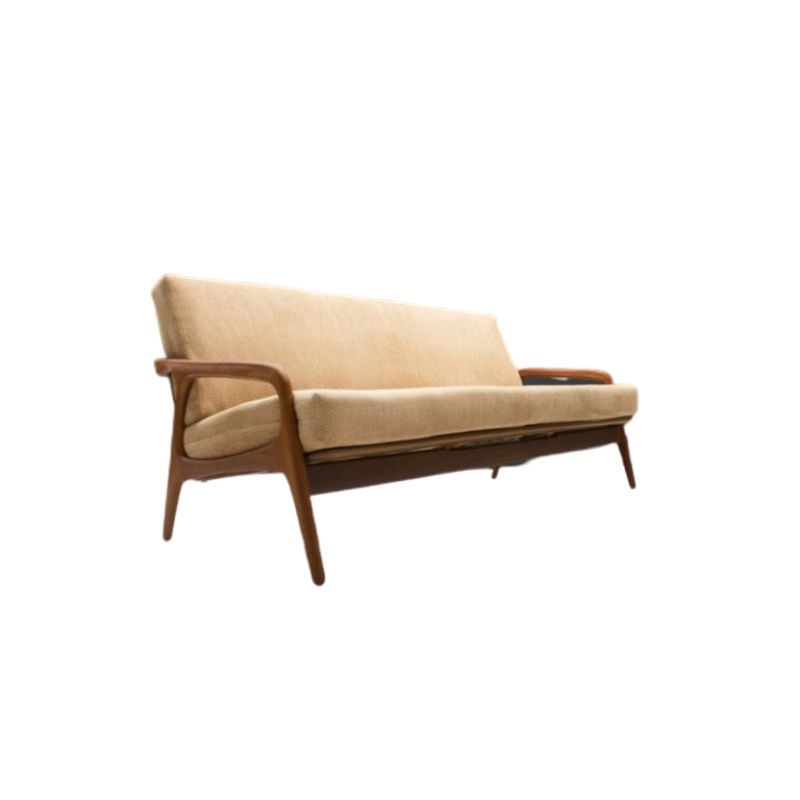
| That does not look like Pearsall to me. The style sort of does but the base isn't quite the same--the front rail of the base on a Pearsall would be flush with the front edge of the legs. As if it was all one piece of wood, for lack of a better way of explaining. Also, the arms: the inner arm has two planes---vertical where it meets the cushion edge, and slanted above that. Pearsalls, I believe, only ever have one slanted plane. The curved piece of wood on the underside is also a clue. A lot of thinner profile sofa decks have this for strength. My sofa has two of them. I am not positive but I don't think Pearsall sofas have this curved piece at all. I think they just have straight boards for added strength. The springs: pretty sure Pearsall just used elastic webbing, not these flat steel springs. I upholstered some armchairs once with these exact springs. They were made by FlexSteel, an American company that made decent quality furniture. The gold-painted steel bars on the underneath are just for added strength and should be covered by a black cambric dust cover over the entire bottom of the sofa (before the walnut base is attached). This is an ambitious upholstery project for a beginner, but doable if you are good at following instructions and you have the right tools and the time to commit to it. I recommend the 1978 Sunset Press book on furniture upholstery (extremely thorough step-by-step instructions, lots of diagrams--i taught myself upholstery using this book and it's still the best one out there, in my opinion--lots of copies available for a few bucks on Amazon and Ebay). This sofa most likely has a conventional hardwood frame that is essentially the same as a traditional sofa frame. The only thing that will be different is the back, which has the two short end sections. Just pay attention to how it was done as you strip it, and take lots of photos and notes! Also, get a Berry staple pulling tool. You're gonna need it. | |||||
| HP... | 1 Relevance | 19 years ago | dcwilson | General discussion | |
| HP... The radios you pictured are perhaps not a useful comparison with a mixer, since it would be rather busy to have a perfectly rectilinear mixer in a brushed aluminum case covered with 15 or 20 perfectly round, machined knobs of varying sizes when only one was needed. 🙂 "Shrewish" is also an aesthetics term with which I am unfamiliar, though I kind of like the sound of it. 😉 Regarding your distaste for trapezoids, I am not quite sure how to respond. Would you consider it persuasive and enlightening criticism by me, if I were to say I do not like the radios you pictured, because I intrinsically detest circles and squares? Probably not. One has to look at the forms played with and evaluate whether the way they are managed is deft aesthetically and contribute favorably to function. If they add function and pleasing form, making injection moulding harder (and this case of the HP Mixette hardly seems a challenge in this regard) becomes a worthwhile tradeoff, if you can sell the thing at the resulting price point. Frankly, I thought one of the tenants of modernist design was a willingness to explore composition in a form language that included most kinds of geometric forms where and when these forms contributed positively to the function. Also, I thought it was okay to make use of abstraction where it simplified the interface with an object and so improved function (we don't have to expose structure and underlying components, if doing so fails to make something easier to use). Having held and used this Mixette, I think the trapezoidal compositions and abstraction of structure (covering of electronic innards) contribute postively on both counts. Its easy to handle. Well balanced. More pleasing visually than most mini mixers I've seen. And I think about what I'm mixing and not about the mixer (except for the speed button), when I am using it. There is no law that says all electric appliances need to look like a Grundig electric radio by Porsche. Frankly, I wouldn't mind seeing Porche break out a little. Surely the company that penned the 911 sports car can do more than circles and squares. | |||||
| Thanks all! | 1 Relevance | 17 years ago | Gustaf | General discussion | |
| Thanks all! Heath, there is the Wegner Heart chair (image 1). Is that the one? It is lovely, but maybe not the ideal match. I wanted to see alternatives. Having something custom made in a matching style could be an interesting option, although I would prefer to explore more readily available models first. Vintage if possible, especially as the table is new. rockland, yes tough indeed. Those are the exact questions I ask myself. But that is a fab chair! I had not heard about Emiliano Godoy before. I like his work. Is the chair ash? In production? Comfortable? I guess the latter could be questioned, at least based on its looks. Going in the other direction, I think black powder coated steel would be a great match. If Prouvé's Standard chair was available with three legs, it might be the perfect choice. SDR, thanks for the input. Long term stability is indeed key here. But a dining chair also needs to be light. I move mine around frequently. I read up a bit on the Papst chair in the linked pdf. It was designed to provide various sitting positions, including backwards, where the backrest then provides chest support: "The curved backrest form, the conical structure of the rear chair legs and the form of the seat platform supported the requirement of a chair that could also be sat upon the other way round in order to promote changes in posture and movement. The backrest then serves as an ergonomic chest support. When the user sits on the chair sideways, the backrest also provides support and functions as a convenient and pleasant armrest. Last but not least, the seat platform, tapered towards the front, facilitates circular grouping of chairs in order to support communication and interaction." Brilliant, if it works, isn't it? I'd love to try one. I also found a picture of the underside (image 2). One more thing to consider is that the room is very small, with an oak table on an oak floor. I think the materials need to be balanced with that in mind. Do you all think another light wood, such as ash or beech, would work in this context? http://www.wilkhahn.com/documents/Papst_D_EN.pdf | |||||
| Gehry's AGO building is easy to appreciate | 1 Relevance | 16 years ago | fastfwd | General discussion | |
| Gehry's AGO building is easy to appreciate if you understand its design goals and see photos from different angles. What you're seeing in the photo above is the BACK of the building. You can also see the 200-year-old house that originally held the gallery, but what you can't see are the numerous additions and expansions in various architectural styles that had ALREADY been made to that building over the last hundred years. Gehry's task was to unify that mess; if you look at the whole thing, you'll see that he did it in a way that's really very conservative (especially for him). The Wikipedia page contains excerpts from some newspaper articles: ---------------------------------------------------------- http://en.wikipedia.org/wiki/Art_Gallery_of_Ontario The Toronto Star called it "the easiest, most effortless and relaxed architectural masterpiece this city has seen", with the Washington Post commenting: "Gehry's real accomplishment in Toronto is the reprogramming of a complicated amalgam of old spaces. That's not sexy, like titanium curves, but it's essential to the project." The architecture critic of the New York Times wrote: "Rather than a tumultuous creation, this may be one of Mr. Gehry's most gentle and self-possessed designs. It is not a perfect building, yet its billowing glass facade, which evokes a crystal ship drifting through the city, is a masterly example of how to breathe life into a staid old structure. And its interiors underscore one of the most underrated dimensions of Mr. Gehry's immense talent: a supple feel for context and an ability to balance exuberance with delicious moments of restraint. Instead of tearing apart the old museum, Mr. Gehry carefully threaded new ramps, walkways and stairs through the original." ---------------------------------------------------------- Photos of Gehry's model from various angles are at the link below, and a Google Image search will turn up lots and lots of interior and exterior shots of the actual building. It's really not the architectural disaster that it might appear to be when viewed only from the back and without any context. http://www.designboom.com/contemporary/art_gallery_of_ontario.html | |||||



If you need any help, please contact us at – info@designaddict.com