

Search result for: di frutta
| # | Post Title | Result Info | Date | User | Forum |
| N.O. møller did not design | 1 Relevance | 10 years ago | leif ericson - Zephyr Renner | General discussion | |
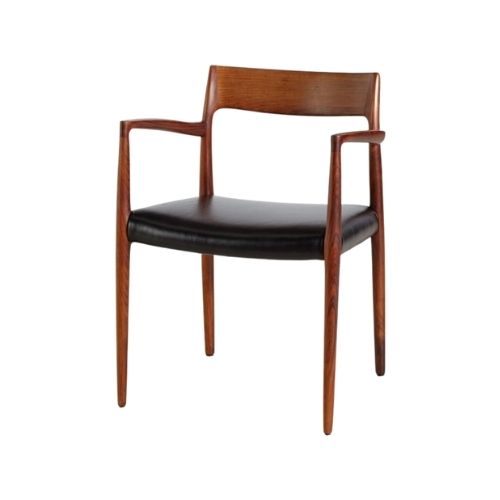
| N.O. møller did not design for Gudme. I don't think the credenza is Fritz Hansen. There must be some mistake there. And I share your sentiments about it. The last Slagelse chair I saw was very, very nicely made, but it almost one of a kind. And those chairs do look like Møller 77s to me. Hard to go wrong with a Møller chair. The earlier ones are better than the later ones. Check for the Møller models stamp. It is post circa 71. Check the joint between the side rails and rear legs. It can loosen. The chair is not damaged, but when it gets a new seat you wou ... | |||||
| I don't know who designed or | 1 Relevance | 10 years ago | Spanky | General discussion | |
| ... tools to do it well. Sheet cane comes pre-woven in sheets and you can get various styles of weave, including the one that's on the chair now. You need a cane chisel to remove the spline that holds the sheet of cane in the groove. It's possible to use a screwdriver or wood chisel but a cane chisel works better and is less likely to damage the wood at the edge of the groove. I have used all of the above and the cane chisel is definitely the way to go. You will need a set of 8 or so wooden wedges that are made for replacing sheet cane, and it's best to use t ... | |||||
| Addition of a cabinet? | 1 Relevance | 13 years ago | Catfish | General discussion | |
| Addition of a cabinet? Thank you guys! One more question: is it possible to hang a cabinet component on these rails? The only systems that I've seen involve either diagonal wood pegs that fit into holes in the vertical wall rails, or clips that seem to be meant to hang on a horizontal bar. Obviously neither of those would be compatible with my system. Would anyone have any experience with this? Thanks again! | |||||
| Yes, it's | 1 Relevance | 13 years ago | SDR | General discussion | |
| Yes, it's Rietveldt -- from 1935. The reference I have mentions "visible diagonal stitching" to the wool upholstery. Here Rietveldt continues with the exploration of the dialog between the verticals and horizontals of architectural construction -- and, indeed, of Cartesian geometries in general -- and the diagonals dictated by the function of the object, namely a comfortable chair, a dialog which began (for him) in 1918 with the Red and Blue chair. The architect returned to this form, with development, in 1958, in a commission for a new press room at UNESC ... | |||||
| It's good to have feedback | 1 Relevance | 10 years ago | SDR | General discussion | |
| ... while the "legs" do not. Why ? What is the aesthetic rationale for that move ? Wouldn't the design be equally valid if the base were turned upside down ? Just asking . . . The design presented a the top of this page has the benefit of an rationalized design, where arms and legs are treated identically. Pearsall's quasi-knockoff design has four pairs of limbs rather than three, and an even simpler profile to the limbs. Not the same table; it could be analyzed on its own terms, perhaps. Finally, I'd be most curious to know how the central joint is han ... | |||||
| Manual staplers and most (all | 1 Relevance | 10 years ago | Spanky | General discussion | |
| ... that's after a lot of effort on my part to make them work. A pneumatic staple gun and compressor are best---fastest, easiest to use, and they do an excellent job of anchoring upholstery materials and the staples are smaller gauge so you don't have to worry about splitting the wood. The compressor shoots them in all the way but you can also do temporary tacks by holding the stapler head tilted to the side so that only one leg of the staple goes all the way in. Pull it out later with diagonal pliers. If you don't want to invest in a compressor and staple gu ... | |||||
| When I first encountered this | 1 Relevance | 10 years ago | SDR | General discussion | |
| When I first encountered this joint, co-workers were encumbered with the notion that the frame had to be held diagonally -- somehow -- and pushed all the way through the blade, to create the diagonal slot (mortise). It seemed to me that an easier and more effective approach would be to place one edge of the frame flat on the saw table and move it into the blade far enough to create the desired depth. This sometimes makes an asymmetrical mortise -- deeper along one edge of the frame than the other, depending on how high the saw blade can be raised -- but if ... | |||||
| As the legs are painted black | 1 Relevance | 10 years ago | SDR | General discussion | |
| ... the drill press; perhaps a custom-made doweling jig of hardwood, bored at the correct angles and clamped to the workpiece, wold be the way to go. You'll need one jig for the upper joints, another for the lower ones, because of the differing angles. Or, you could align yourself with the restoration/preservation experts who believe that recreated parts should be distinguishable from historic original ones; you could use visible joinery like the corner spline (a pair at each corner would be nice). They'll be mostly disguised under the paint but still visibl ... | |||||
| Love it. | 1 Relevance | 13 years ago | SDR | General discussion | |
| Love it. And the perspective reminds me of a favorite image, this 1929 lithograph by Louis Lozowick. Interesting that both images have a diagonal checkerboard raster as a background . . . | |||||
| Quite nice. | 1 Relevance | 13 years ago | SDR | General discussion | |
| Quite nice. I wonder how the grain goes, on the largest piece of the side frame ? The direction isn't visible as the piece goes from diagonal to horizontal. Maybe they found "knees," like the builders of barn roof framing, and boats, in times past . . . wood taken from trees whose branching form provides such shapes. Prolly knot. | |||||
| I wonder if it had to do with the fabric. | 1 Relevance | 14 years ago | Spanky | General discussion | |
| I wonder if it had to do with the fabric. "Cato" is a very large scale weave and it would have ended up with a diagonal, or bias, seam if they took it all the way to the center line. This is kind of an unstable seam in that particular fabric, unless it has a heavier backing on it (which it might not, because that might keep it from hugging the curves of that chair as well). So...I dunno. But that would be my first guess. | |||||
| Here's a pic of some gorgeous | 1 Relevance | 11 years ago | Spanky | General discussion | |
| Here's a pic of some gorgeous genuine rush seats. Someone brought a real rush seat--very old---to me recently to redo and i was surprised at how crazy the underside was. There were little cut ends sticking out all along the diagonal seams--like at every strand. It was very neatly done but just so much more rustic than any paper cord seat. Thankfully the seat was in good shape and I told her to just enjoy it as is! I think this is the natural thickness of this stuff, and that's why people put pieces of cardboard between the layers when weaving fiber rush (w ... | |||||
| Leif, that's true-- | 1 Relevance | 11 years ago | Spanky | General discussion | |
| Leif, that's true---consistent tension is very important! But it's easy on the back corners to start a little off 90 degrees since the side rails are so much higher than the back rail. Picturing a diagonal line from the center of a rear post to the point where the wraps end on the front rail could help but that requires some good visualization skills. And the crisp 90 degree angle is tough with stiffer, heavier cord, even when you really yank on it. But certainly it can be done. I am still pining for one of those flat clips they use in Denmark. I use a ... | |||||
| Don't mean to hijack the | 1 Relevance | 11 years ago | cdsilva | General discussion | |
| ... effort with a drilled diagonal wood dowel had also failed. Combine that with a difficult location near the side stretcher, and I was not very optimistic of getting a tight fit for the repair. The repair piece insert is a hanger bolt, with wood threads on one side and bolt threads on the other. I had initially planned on doing a PVC-pipe-guided drill effort, a la tchp's excellent repair job for a Round Chair from last year. However, the stretcher location and non-round cross section of the leg at this location made it impractical. After a few months of debat ... | |||||
| Thanks for the response. ... | 1 Relevance | 14 years ago | gene | General discussion | |
| Thanks for the response. ... Thanks for the response. Yes, the edge is solid wood and In the second photo, next to the seam (if that's the right word) there is a diagonal line which might just look like a scratch but is actually a crack. There isn't any wood missing ,though. I guess I can get an estimate from a restorer easily enough. Just wondering if refinishing devalues it? | |||||



If you need any help, please contact us at – info@designaddict.com